2026 US 50-State + DC Crypto Capital Gains Tax Rates & Forms Directory
Select any US state or territory below to launch a pre-configured 2026 Federal + State + 3.8% NIIT Crypto Tax Calculator, verify special long-term capital gains deductions (AZ 25%, AR 50%, SC 44%, WI 30%, WA 7% LTCG excise), and check state tax return schedules.
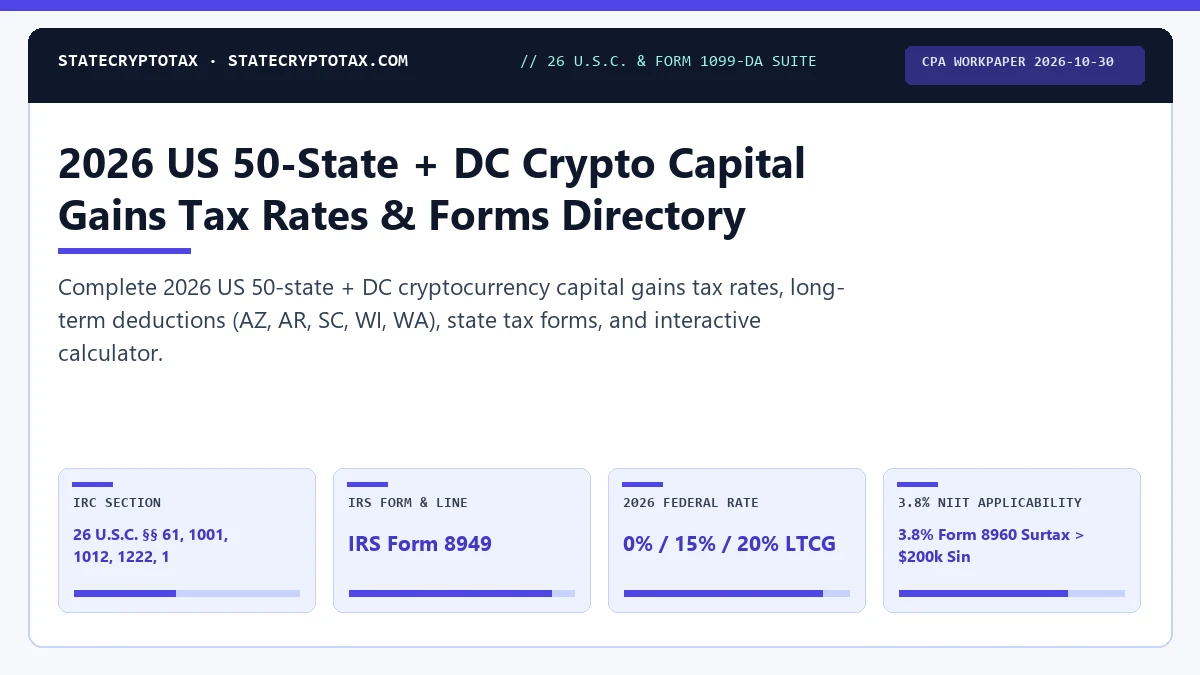
- IRC Section
- 26 U.S.C. §§ 61, 1001, 1012, 1222, 1411, 6045
- IRS Form & Line
- IRS Form 8949 (Parts I & II) → Schedule D (Form 1040)
- 2026 Federal Rate
- 0% / 15% / 20% LTCG (>365d) · 10%–37% STCG (Rev. Proc. 2025-32)
- 3.8% NIIT Applicability
- 3.8% Form 8960 Surtax > $200k Single / $250k MFJ (IRC § 1411)
- 1099-DA Box Mapping
- Box 1f Proceeds → Col (d) · Box 1g Basis → Col (e) · Box 3b/9
- Statute of Limitations / Rev. Proc.
- 3 Yrs Standard (IRC § 6501(a)) · 6 Yrs >25% Omission · Rev. Proc. 2024-28
▸ Inspect 1200×675 CPA Statutory Workpaper Summary Card (2026 US 50-State Crypto Capital Gains Tax ) WebP 1200×675
Interactive 50-State + Federal Combined Crypto Tax Calculator
IRS Statutory Rule: 2026 US 50 is governed in 2026 by IRS Rev. Proc. 2025-32 (0%/15%/20% long-term brackets plus 3.8% NIIT) and mandatory Form 1099-DA gross proceeds reporting.
2026 State Crypto Capital Gains Summary Tiers
IRS Statutory Rule: 2026 US 50 is governed in 2026 by IRS Rev. Proc. 2025-32 (0%/15%/20% long-term brackets plus 3.8% NIIT) and mandatory Form 1099-DA gross proceeds reporting.
No State Tax on Short- or Long-Term Crypto Gains
AK, FL, NV, NH, SD, TN, TX, WY levy 0% state individual income tax on cryptocurrency capital gains and staking rewards (New Hampshire repealed its Interest & Dividends tax effective Jan 1, 2025).
Statutory LTCG Rate Reductions
AR (50%), SC (44%), WI (30%), AZ (25%), MT, NM, ND, VT, HI provide statutory deductions or lower rate caps when you hold crypto for more than 365 days under IRC § 1222.
CA (13.3%), NY/NYC (14.78%), WA (7% LTCG)
California taxes all crypto gains as ordinary income up to 13.3%. Washington imposes 0% on short-term gains and staking, but levies a 7% excise tax on long-term capital gains above $270,000.
Complete 2026 50-State + DC + Puerto Rico Crypto Tax Table
IRS Statutory Rule: 2026 US 50 establishes the following verified 2026 benchmark values under “Complete 2026 50-State + DC + Puerto Rico Crypto Tax Ta”: Alabama (AL) (5.00% · Alabama Department of Revenue), Alaska (AK) (0.00% · Alaska Department of Revenue), Arizona (AZ) (2.50% · Arizona Department of Revenue).
| Jurisdiction | 2026 Top Rate | State Tax Agency | State Tax Form | Long-Term Capital Gains & Special Rules | Exchange Staking |
|---|---|---|---|---|---|
| Alabama (AL) | 5.00% | Alabama Department of Revenue | Form 40 + Schedule D | Taxed as ordinary income up to 5.0%; Alabama allows a deduction for federal income taxes paid. | Restricted (State Order) |
| Alaska (AK) | 0.00% | Alaska Department of Revenue | None (No State Individual Income Tax) | 0% state individual income tax and 0% state capital gains tax (federal capital gains tax still applies). | Permitted |
| Arizona (AZ) | 2.50% | Arizona Department of Revenue | Form 140 | Flat 2.50% state income tax rate, PLUS a 25% deduction on net long-term capital gains (reducing the effective Arizona long-term capital gains tax rate to 1.875%). | Permitted |
| Arkansas (AR) | 3.90% | Arkansas Department of Finance and Administration | Form AR1000F | 50% state tax exclusion on net long-term capital gains (effective max LT rate ~1.95%), and 100% exclusion on net long-term capital gains exceeding $10 million. | Permitted |
| California (CA) | 13.30% | California Franchise Tax Board (FTB) | Form 540 + Schedule D (540) | None — California taxes all short-term and long-term capital gains as ordinary income up to 13.30% (14.40% when including the 1.1% SDI payroll/high-earner surcharge where applicable). Highest state capital gains rate in the US. | Restricted (State Order) |
| Colorado (CO) | 4.40% | Colorado Department of Revenue | Form DR 0104 | Flat 4.40% state income tax on federal taxable income; Colorado accepts cryptocurrency for state tax payments via PayPal (converted to USD at checkout). | Permitted |
| Connecticut (CT) | 6.99% | Connecticut Department of Revenue Services | Form CT-1040 | Taxed as ordinary income up to 6.99% (plus up to 2% phase-out recapture for high earners). | Permitted |
| Delaware (DE) | 6.60% | Delaware Division of Revenue | Form PIT-RES | Taxed as ordinary income up to 6.60% on income over $60,000; no preferential long-term capital gains deduction. | Permitted |
| District of Columbia (DC) | 10.75% | DC Office of Tax and Revenue (OTR) | Form D-40 | Taxed as ordinary income up to 10.75% (on income over $1,000,000); no preferential long-term capital gains rate. | Permitted |
| Florida (FL) | 0.00% | Florida Department of Revenue | None (No State Individual Income Tax) | 0% state individual income tax and 0% state capital gains tax (constitutionally prohibited in Florida). | Permitted |
| Georgia (GA) | 5.19% | Georgia Department of Revenue | Form 500 | Flat state income tax rate of 5.19% (phasing down from 5.39% under HB 1437 / HB 1015); no separate long-term capital gains exclusion. | Permitted |
| Hawaii (HI) | 7.25% | Hawaii Department of Taxation | Form N-11 | Hawaii caps the tax rate on net long-term capital gains at 7.25%, compared to the top ordinary income rate of 11.0%. | Permitted |
| Idaho (ID) | 5.70% | Idaho State Tax Commission | Form 40 | Flat 5.695% state income tax rate; Idaho capital gains deduction applies only to qualifying tangible/real Idaho property, not cryptocurrency. | Permitted |
| Illinois (IL) | 4.95% | Illinois Department of Revenue | Form IL-1040 | Flat 4.95% state individual income tax rate on federal adjusted gross income (includes all short-term and long-term capital gains). | Restricted (State Order) |
| Indiana (IN) | 2.95% | Indiana Department of Revenue | Form IT-40 | Flat 2.95% state income tax rate in 2026 (phasing down to 2.90% in 2027 under HEA 1002), plus county income tax (~1%–3%). | Permitted |
| Iowa (IA) | 3.80% | Iowa Department of Revenue | Form IA 1040 | Flat 3.80% state income tax rate (effective Jan 1, 2025 onward under SF 2442); capital gains from crypto are taxed at the flat 3.80% rate. | Permitted |
| Kansas (KS) | 5.58% | Kansas Department of Revenue | Form K-40 | Two-bracket system (5.20% and 5.58% under 2024 SB 1); all crypto capital gains are taxed at ordinary state rates. | Permitted |
| Kentucky (KY) | 4.00% | Kentucky Department of Revenue | Form 740 | Flat 4.00% state income tax rate (reduced to 3.50% effective Jan 1, 2026 under HB 1); no separate capital gains deduction. | Restricted (State Order) |
| Louisiana (LA) | 3.00% | Louisiana Department of Revenue | Form IT-540 | Flat 3.00% state individual income tax rate (effective Jan 1, 2025 under the 2024 Louisiana tax reform replacing the 1.85%–4.25% brackets). | Permitted |
| Maine (ME) | 7.15% | Maine Revenue Services | Form 1040ME | Taxed as ordinary income up to 7.15%; no long-term capital gains preference. | Permitted |
| Maryland (MD) | 5.75% | Comptroller of Maryland | Form 502 | Top state rate of 5.75% plus mandatory county income tax (2.25% to 3.20%), yielding a combined top marginal rate of up to 8.95%. | Restricted (State Order) |
| Massachusetts (MA) | 8.50% | Massachusetts Department of Revenue | Form 1 + Schedule B & Schedule D | Short-term capital gains (<1 yr) are taxed at 8.50%; long-term capital gains (>1 yr) are taxed at 5.00% (plus the 4% 'Millionaire Surtax' on total annual income above ~$1.08M, making max rates 9.0% LT / 12.5% ST). | Permitted |
| Michigan (MI) | 4.25% | Michigan Department of Treasury | Form MI-1040 | Flat 4.25% state income tax on federal adjusted gross income; no preferential long-term capital gains deduction. | Permitted |
| Minnesota (MN) | 9.85% | Minnesota Department of Revenue | Form M1 | Top ordinary income bracket of 9.85%, PLUS a 1.00% Minnesota Net Investment Income Tax on net investment income (including crypto capital gains) over $1,000,000 (combined top rate: 10.85%). | Permitted |
| Mississippi (MS) | 4.40% | Mississippi Department of Revenue | Form 80-105 | Flat 4.40% state income tax in 2026 on income above $10,000 (down from 4.70% in 2025 under HB 531). | Permitted |
| Missouri (MO) | 4.70% | Missouri Department of Revenue | Form MO-1040 | Top marginal rate of 4.70% (Missouri legislative bills in 2025 proposed eliminating state capital gains tax; check current tax year instructions for Phase-in exclusions). | Permitted |
| Montana (MT) | 4.10% | Montana Department of Revenue | Form 2 | Montana is the ONLY US state with no money transmitter license requirement at all. For taxes, Montana taxes net long-term capital gains at preferential lower brackets of 3.0% and 4.1% (vs 5.9% top ordinary rate). | Permitted |
| Nebraska (NE) | 5.20% | Nebraska Department of Revenue | Form 1040N | Top state income tax rate of 5.20% in 2026 (phasing down to 3.99% by 2027 under LB 754); no special crypto capital gains deduction. | Permitted |
| Nevada (NV) | 0.00% | Nevada Department of Taxation | None (No State Individual Income Tax) | 0% state individual income tax and 0% state capital gains tax. | Permitted |
| New Hampshire (NH) | 0.00% | New Hampshire Department of Revenue Administration | None (No State Individual Income Tax) | 0% state income tax and 0% capital gains tax (New Hampshire's legacy Interest & Dividends Tax was fully repealed effective January 1, 2025). | Permitted |
| New Jersey (NJ) | 10.75% | New Jersey Division of Taxation | Form NJ-1040 | Taxed as ordinary income up to 10.75% (on income over $1,000,000); New Jersey does not allow net capital losses to offset ordinary income (and does not allow capital loss carryforwards on NJ-1040). | Restricted (State Order) |
| New Mexico (NM) | 5.90% | New Mexico Taxation and Revenue Department | Form PIT-1 | Taxpayers may deduct the GREATER of $1,000 or 40% of net capital gains for New Mexico income tax (reducing the effective top long-term capital gains rate from 5.90% to ~3.54%). | Permitted |
| New York (NY) | 10.90% | New York State Department of Taxation and Finance | Form IT-201 | Taxed as ordinary income up to 10.90% state rate, PLUS up to 3.876% New York City local income tax for NYC residents (combined top rate: 14.776%). | Restricted (State Order) |
| North Carolina (NC) | 4.25% | North Carolina Department of Revenue | Form D-400 | Flat 4.25% state income tax rate in 2025/2026 (scheduled to step down to 3.99% subject to revenue triggers); no separate capital gains preference. | Permitted |
| North Dakota (ND) | 2.50% | North Dakota Office of State Tax Commissioner | Form ND-1 | Top marginal rate of just 2.50%, PLUS North Dakota allows a 40% exclusion on net long-term capital gains (reducing the effective top long-term rate to 1.50%). | Permitted |
| Ohio (OH) | 3.50% | Ohio Department of Taxation | Form IT 1040 | Top marginal state income tax rate of 3.50% (two brackets: 2.75% and 3.50% on income over $100,000); no separate long-term capital gains deduction. | Permitted |
| Oklahoma (OK) | 4.75% | Oklahoma Tax Commission | Form 511 | Top marginal state rate of 4.75%; Oklahoma capital gains deduction is limited to Oklahoma-headquartered corporations/real property, so crypto is taxed at ordinary rates. | Permitted |
| Oregon (OR) | 9.90% | Oregon Department of Revenue | Form OR-40 | Taxed as ordinary income up to 9.90% (plus Portland Metro & Multnomah County high-earner taxes up to ~4% for Portland residents); no preferential long-term capital gains rate. | Permitted |
| Pennsylvania (PA) | 3.07% | Pennsylvania Department of Revenue | Form PA-40 + Schedule D | Flat 3.07% Pennsylvania personal income tax on net gains from the sale, exchange, or disposition of property (Note: PA only allows capital losses to offset capital gains within the same tax year — no carryforward). | Permitted |
| Rhode Island (RI) | 5.99% | Rhode Island Division of Taxation | Form RI-1040 | Taxed as ordinary income up to 5.99%; no long-term capital gains tax preference. | Permitted |
| South Carolina (SC) | 6.20% | South Carolina Department of Revenue | Form SC1040 | South Carolina provides a generous 44% deduction on net long-term capital gains held >1 year (reducing the top 6.20% state rate to an effective ~3.47% on long-term crypto gains). | Restricted (State Order) |
| South Dakota (SD) | 0.00% | South Dakota Department of Revenue | None (No State Individual Income Tax) | 0% state individual income tax and 0% state capital gains tax. | Permitted |
| Tennessee (TN) | 0.00% | Tennessee Department of Revenue | None (No State Individual Income Tax) | 0% state individual income tax and 0% state capital gains tax (Hall Income Tax fully repealed in 2021). | Permitted |
| Texas (TX) | 0.00% | Texas Comptroller of Public Accounts | None (No State Individual Income Tax) | 0% state individual income tax and 0% state capital gains tax (constitutionally prohibited in Texas). | Permitted |
| Utah (UT) | 4.55% | Utah State Tax Commission | Form TC-40 | Flat 4.55% state income tax rate; Utah offers a nonrefundable taxpayer tax credit that phases out at higher incomes. | Permitted |
| Vermont (VT) | 8.75% | Vermont Department of Taxes | Form IN-111 | Top marginal rate of 8.75%; Vermont allows a flat $5,000 exclusion on net long-term capital gains (the 40% exclusion applies only to qualified business/farm/timber assets, not cryptocurrency). | Restricted (State Order) |
| Virginia (VA) | 5.75% | Virginia Tax | Form 760 | Top marginal state income tax rate of 5.75% (applies to taxable income above $17,000); no special long-term capital gains deduction for crypto. | Permitted |
| Washington (WA) | 7.00% | Washington Department of Revenue | WA Capital Gains Excise Tax Return (only if net LT cap gains exceed ~$270,000) | 0% state tax on ordinary income (staking, mining, wages) and 0% on short-term capital gains, BUT Washington imposes a 7.0% excise tax on net long-term capital gains exceeding the annual standard deduction (~$270,000 in 2025/2026, RCW 82.87). | Restricted (State Order) |
| West Virginia (WV) | 4.82% | West Virginia State Tax Department | Form IT-140 | Top marginal rate of 4.82% (reduced from 5.12% under WV tax cuts); all capital gains are taxed as ordinary income. | Permitted |
| Wisconsin (WI) | 7.65% | Wisconsin Department of Revenue | Form 1 + Schedule WD | Wisconsin allows a 30% deduction on net long-term capital gains held >1 year (reducing the top 7.65% marginal rate to an effective ~5.355% on long-term crypto capital gains). | Restricted (State Order) |
| Wyoming (WY) | 0.00% | Wyoming Department of Revenue | None (No State Individual Income Tax) | 0% state individual income tax and 0% state capital gains tax. | Permitted |
| Puerto Rico (PR — Act 60) | 0.00% (Post-Move Act 60) | PR Departamento de Hacienda & IRS (§ 937) | PR Form 482 + IRS Form 8898 | 0% on post-move appreciation for bona fide PR residents under IRC § 937; pre-move unrealized gains remain US-source taxable for 10 years. | Permitted |
High-Tax vs Zero-Tax State Domicile & Relocation Comparisons
IRS Statutory Rule: 2026 US 50 establishes the following verified 2026 benchmark values under “High-Tax vs Zero-Tax State Domicile & Relocation Compar”: Step 1 — Reconcile 1099-DA Box 1f Proceeds: Match custodial broker gross proceeds aga.
California (13.3%) vs Texas (0%)
FTB residency audit rules, 546-day safe harbor, and tax savings on $100k–$1M crypto gains.
New York (10.9%) vs Florida (0%)
NYS 183-day statutory residency test, domicile factors, and BitLicense access comparison.
California (13.3%) vs Nevada (0%)
Comparing FTB Schedule D-1 tax stack against Nevada 0% income tax domicile.
Washington (7% LTCG) vs Wyoming (0%)
Washington $270k LTCG excise tax vs Wyoming 0% income tax and SPDI banking regime.
New Jersey (10.75%) vs Florida (0%)
NJ Form NJ-1040 Schedule B disposition rules vs Florida homestead domicile.
Illinois (4.95%) vs Texas (0%)
Illinois flat 4.95% Form IL-1040 Schedule D vs Texas 0% state capital gains tax.
Federal + State Stacking
1099-DA State Reporting
Wallet-by-Wallet Accounting
2026 IRS Compliance Chain, Form 1099-DA Workflow & Disallowance Rules: 2026 US 50
IRS Statutory Rule: 2026 US 50 is governed in the 2026 tax year by IRC §§ 1001, 1221, and 1222, IRS Notice 2014-21, Rev. Proc. 2024-28, and Rev. Proc. 2025-32, taxing short-term dispositions (≤ 365 days) at ordinary rates up to 37% and long-term gains (> 365 days) at 0%, 15%, or 20% plus the 3.8% Net Investment Income Tax (NIIT).
- Segregate Per-Wallet Cost Basis Pools (Rev. Proc. 2024-28): The taxpayer maintains separate FIFO or Specific-ID cost basis ledgers for each custodial broker and each self-custodied wallet address.
- Ingest Broker Form 1099-DA Statements: By February 15, custodial exchanges issue Form 1099-DA reporting gross proceeds (Box 1f) and covered cost basis for each digital asset sale or swap.
- Classify Ordinary Income vs. Capital Gains: Staking rewards, mining payouts, and airdrops are recorded on Schedule 1 / Schedule C at fair market value in USD at the exact timestamp of dominion and control.
- Populate IRS Form 8949 (Parts I & II): Dispositions are separated into Part I (Short-Term ≤ 365 days) and Part II (Long-Term > 365 days) using Checkboxes G, H, I (short-term) or J, K, L (long-term).
- Apply State Income Tax Conformity: Net capital gains flow from federal Schedule D to the taxpayer's state return (0% in AK, FL, NV, NH, SD, TN, TX, WA, WY vs. up to 13.3% in California).
- Answer the Form 1040 Digital Asset Question: The filer checks “Yes” or “No” on page 1 of Form 1040 and retains cryptographic transaction logs for the 3-to-6-year IRS statute of limitations (IRC § 6501).
Statutory Myth Debunked (Restriction): A tax-free crypto-to-crypto or BTC-to-USDT stablecoin swap under IRC § 1031 like-kind exchange rules does not exist: Congress restricted IRC § 1031 exclusively to real property under the Tax Cuts and Jobs Act, making every coin-to-coin trade, DeFi liquidity swap, and stablecoin conversion an immediately taxable disposition under IRC § 1001.
To model exact liabilities for 2026 US 50, run the 2026 federal and 50-state crypto capital gains tax calculator incorporating IRS Rev. Proc. 2025-32 brackets (0%, 15%, 20%) plus 3.8% NIIT (short-term vs long-term 365-day holding threshold), verify reporting codes in our interactive IRS Form 1099-DA box-by-box reconciliation guide under Treasury Decision 10000 (89 FR 56480) gross proceeds reporting (Form 8949 Part I and Part II adjustment codes), and review wallet-by-wallet cost basis allocation under Rev. Proc. 2024-28 (mandatory per-account FIFO/Specific ID tracking from January 1, 2026).
2026 IRS Form 1099-DA & 8949 Filing Readiness Tracker
0 / 4 Complete2026 IRS Rev. Proc. & State Tax Rate Dispatch
Title 26 AlertsReceive instant CPA alerts when the IRS issues new Form 1099-DA guidance, Internal Revenue Bulletins, or 50-state capital gains rate amendments—or download this page's statutory workpaper `.txt` file.
Statutory Frequently Asked Questions & IRS Citations
IRS Statutory Rule: 2026 US 50 is governed in 2026 by IRS Rev. Proc. 2025-32 (0%/15%/20% long-term brackets plus 3.8% NIIT) and mandatory Form 1099-DA gross proceeds reporting.
Which US states have 0% cryptocurrency capital gains tax in 2026?
Eight US states levy 0% state individual income tax on both short-term and long-term crypto capital gains as well as staking/mining rewards in 2026: Alaska (AK), Florida (FL), Nevada (NV), New Hampshire (NH), South Dakota (SD), Tennessee (TN), Texas (TX), and Wyoming (WY).
Can I avoid California or New York state crypto tax by opening an LLC in Wyoming or Delaware?
No. Individual capital gains from personal cryptocurrency sales and pass-through single-member LLCs are sourced to your state of personal domicile/residency at the time of the disposition, not where an LLC is registered.
Which US states charge 0% state capital gains tax on cryptocurrency in 2026?
Nine US states levy no state individual income tax on ordinary income or capital gains in 2026: Alaska, Florida, Nevada, New Hampshire, South Dakota, Tennessee, Texas, Washington (which charges 0% on ordinary income and short-term gains but imposes a 7% excise tax on long-term capital gains above $270,000), and Wyoming.
Which US states impose the highest combined federal + state crypto tax rates in 2026?
California (13.30% top rate on Form 540 with zero long-term preference), New York (10.90% top state rate on Form IT-201, plus up to 3.876% for NYC residents), New Jersey (10.75%), Oregon (9.90%), Minnesota (9.85%), and District of Columbia (10.75%) produce the highest combined federal + NIIT + state burdens in 2026.
How do Form 1099-DA Boxes 14, 15, and 16 affect state crypto tax audits in 2026?
IRS Form 1099-DA includes dedicated state reporting fields: Box 14 (State Code), Box 15 (State Identification Number), and Box 16 (State Tax Withheld). State departments of revenue receive federal information-sharing feeds (IRS Federal-State Exchange Program) and match Schedule D proceeds directly against state returns.
Which states offer special deductions or lower rates for long-term crypto capital gains?
Arkansas (50% long-term capital gains exclusion), South Carolina (44% deduction), Wisconsin (30% exclusion), Arizona (25% deduction), Montana (preferential 3.0%–4.1% LTCG brackets), New Mexico (40% deduction), and Massachusetts (5% long-term rate vs 8.5% short-term rate, plus 4% surtax above $1M) reduce state tax when you hold digital assets over 365 days.