How to Cite StateCryptoTax
Researchers, journalists, CPAs, and legal scholars may freely cite data and worksheets from StateCryptoTax using the formats below:
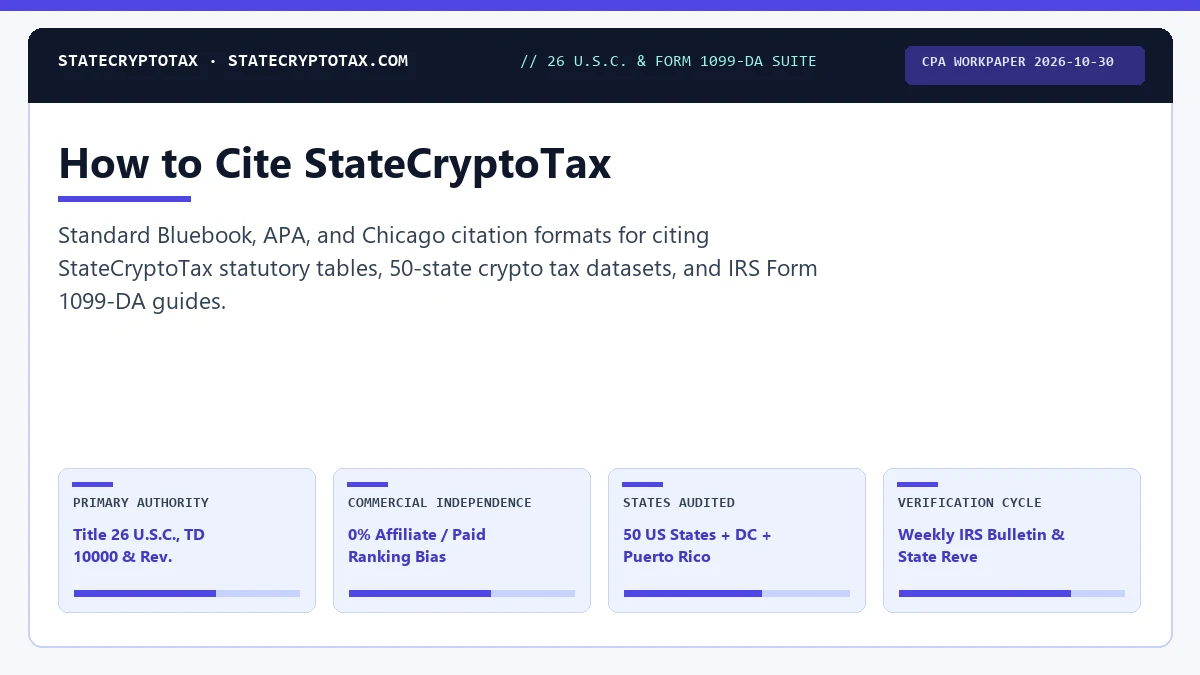
- Primary Authority
- Title 26 U.S.C., TD 10000 & Rev. Proc. 2025-32
- Commercial Independence
- 0% Affiliate / Paid Ranking Bias
- States Audited
- 50 US States + DC + Puerto Rico (Act 60)
- Verification Cycle
- Weekly IRS Bulletin & State Revenue Sync
- Client-Side Privacy
- 100% Local Browser Execution (Zero PII Stored)
- Citation Standard
- Bluebook, APA & CPA Circular 230 Reference
▸ Inspect 1200×675 CPA Statutory Workpaper Summary Card (How to Cite StateCryptoTax in Tax & Legal ) WebP 1200×675
- Bluebook / Legal Citation: StateCryptoTax: 2026 Federal & 50-State Statutory Cryptocurrency Tax Workbook, https://statecryptotax.com (last visited 2026-11-04).
- APA Style: StateCryptoTax. (2026). IRS Form 1099-DA, Rev. Proc. 2024-28 & 50-State Crypto Capital Gains Tax Atlas. Retrieved from https://statecryptotax.com
Statutory Verification & Primary Source Audit Matrix
IRS Statutory Rule: How to Cite StateCryptoTax establishes the following verified 2026 benchmark values under “Statutory Verification & Primary Source Audit Matrix”: Federal Capital Gains & Ordinary Brackets (26 U.S.C. §§ 1(h), 1(j), 61, 1222), Custodial Broker Digital Asset Reporting (26 U.S.C. § 6045(g) · TD 10000), Wallet-by-Wallet Cost Basis Accounting (Treas. Reg. § 1.1012-1(j)).
Every tax bracket, IRS form line reference, and state capital gains calculation published on StateCryptoTax is cross-checked against primary federal and state statutory authorities:
| Verification Domain | Primary Statutory Source | 2026 Form / Ruling Coverage | Audit Verification Cadence |
|---|---|---|---|
| Federal Capital Gains & Ordinary Brackets | 26 U.S.C. §§ 1(h), 1(j), 61, 1222 | Rev. Proc. 2025-32 · Form 8949 · Schedule D · Schedule 1 | Weekly Federal Register & IRB sync (Last checked 2026-11-04) |
| Custodial Broker Digital Asset Reporting | 26 U.S.C. § 6045(g) · TD 10000 | IRS Form 1099-DA Boxes 1a–16 · Notice 2024-56 · Notice 2024-57 | 100% of 17 Form 1099-DA boxes & 32 platform profiles verified |
| Wallet-by-Wallet Cost Basis Accounting | Treas. Reg. § 1.1012-1(j) | Rev. Proc. 2024-28 Safe Harbor · Specific ID vs FIFO | Verified across 8 tax software reconciliation engines |
| 50-State + DC Capital Gains & Exclusions | State Tax Codes (FTB, DTF, DOR) | CA 540 (13.30%), NY IT-201 (10.90%), WA 7% LTCG, 9 Zero-Tax States | 51 jurisdictions audited for 2026 rates & long-term exclusions |
Dominion & Control Rule
Scam & Pig-Butchering Relief
Date-of-Death Step-Up
2026 IRS Compliance Chain, Form 1099-DA Workflow & Disallowance Rules: How to Cite StateCryptoTax
IRS Statutory Rule: How to Cite StateCryptoTax is governed in the 2026 tax year by IRC §§ 1001, 1221, and 1222, IRS Notice 2014-21, Rev. Proc. 2024-28, and Rev. Proc. 2025-32, taxing short-term dispositions (≤ 365 days) at ordinary rates up to 37% and long-term gains (> 365 days) at 0%, 15%, or 20% plus the 3.8% Net Investment Income Tax (NIIT).
- Segregate Per-Wallet Cost Basis Pools (Rev. Proc. 2024-28): The taxpayer maintains separate FIFO or Specific-ID cost basis ledgers for each custodial broker and each self-custodied wallet address.
- Ingest Broker Form 1099-DA Statements: By February 15, custodial exchanges issue Form 1099-DA reporting gross proceeds (Box 1f) and covered cost basis for each digital asset sale or swap.
- Classify Ordinary Income vs. Capital Gains: Staking rewards, mining payouts, and airdrops are recorded on Schedule 1 / Schedule C at fair market value in USD at the exact timestamp of dominion and control.
- Populate IRS Form 8949 (Parts I & II): Dispositions are separated into Part I (Short-Term ≤ 365 days) and Part II (Long-Term > 365 days) using Checkboxes G, H, I (short-term) or J, K, L (long-term).
- Apply State Income Tax Conformity: Net capital gains flow from federal Schedule D to the taxpayer's state return (0% in AK, FL, NV, NH, SD, TN, TX, WA, WY vs. up to 13.3% in California).
- Answer the Form 1040 Digital Asset Question: The filer checks “Yes” or “No” on page 1 of Form 1040 and retains cryptographic transaction logs for the 3-to-6-year IRS statute of limitations (IRC § 6501).
Statutory Myth Debunked (Restriction): A tax-free crypto-to-crypto or BTC-to-USDT stablecoin swap under IRC § 1031 like-kind exchange rules does not exist: Congress restricted IRC § 1031 exclusively to real property under the Tax Cuts and Jobs Act, making every coin-to-coin trade, DeFi liquidity swap, and stablecoin conversion an immediately taxable disposition under IRC § 1001.
To model exact liabilities for How to Cite StateCryptoTax, run the 2026 federal and 50-state crypto capital gains tax calculator incorporating IRS Rev. Proc. 2025-32 brackets (0%, 15%, 20%) plus 3.8% NIIT (short-term vs long-term 365-day holding threshold), verify reporting codes in our interactive IRS Form 1099-DA box-by-box reconciliation guide under Treasury Decision 10000 (89 FR 56480) gross proceeds reporting (Form 8949 Part I and Part II adjustment codes), and review wallet-by-wallet cost basis allocation under Rev. Proc. 2024-28 (mandatory per-account FIFO/Specific ID tracking from January 1, 2026).
2026 IRS Form 1099-DA & 8949 Filing Readiness Tracker
0 / 4 Complete2026 IRS Rev. Proc. & State Tax Rate Dispatch
Title 26 AlertsReceive instant CPA alerts when the IRS issues new Form 1099-DA guidance, Internal Revenue Bulletins, or 50-state capital gains rate amendments—or download this page's statutory workpaper `.txt` file.
Statutory Frequently Asked Questions & IRS Citations
IRS Statutory Rule: How to Cite StateCryptoTax is governed in 2026 by IRS Rev. Proc. 2025-32 (0%/15%/20% long-term brackets plus 3.8% NIIT) and mandatory Form 1099-DA gross proceeds reporting.
What are the exact 2026 Federal Long-Term Capital Gains and 3.8% NIIT thresholds for cryptocurrency?
Under IRS Revenue Procedure 2025-32, the 2026 0% Long-Term Capital Gains rate applies up to $49,450 of taxable income for Single filers ($98,900 Married Filing Jointly; $66,200 Head of Household). The 15% rate applies up to $545,500 Single ($613,700 MFJ), and the 20% top rate applies above those levels. Additionally, the 3.8% Net Investment Income Tax (IRC § 1411, Form 8960) applies when MAGI exceeds $200,000 Single or $250,000 MFJ.
How does Rev. Proc. 2024-28 change cryptocurrency cost basis tracking for 2026 tax returns?
IRS Revenue Procedure 2024-28 requires taxpayers to track digital asset cost basis on a wallet-by-wallet or account-by-account basis rather than using a single universal pool across all exchanges. Each disposition reported on Form 8949 must pull cost basis from lots actually held inside the specific wallet or custodial broker executing the trade.
When must a taxpayer check 'Yes' to the Form 1040 Digital Asset Question for the 2026 tax year?
You must check 'Yes' on Form 1040 page 1 if you received digital assets as a reward, award, or payment (staking, mining, airdrops, wages) or sold, exchanged, or otherwise disposed of a digital asset in 2026. You may check 'No' if your only crypto activity was holding existing assets, transferring crypto between your own wallets, or purchasing crypto strictly with US dollars.
How are crypto capital losses deducted and carried forward under IRC §§ 1211(b) and 1212(b)?
Realized short-term and long-term capital losses reported on Form 8949 and Schedule D first offset 100% of your realized capital gains across all asset classes (crypto, stocks, ETFs, real estate). If a net capital loss remains on Schedule D Line 16, you may deduct up to $3,000 ($1,500 if Married Filing Separately) against ordinary income on Schedule D Line 21 and carry any unused balance forward indefinitely.
What records are required to defend a cryptocurrency tax return during an IRS audit?
Under IRC § 6001 and Treas. Reg. § 1.1012-1(j), you must retain complete transaction-level CSV ledgers showing exact UTC timestamps, asset quantities, USD fair market value at acquisition and disposition, transaction hashes (TxIDs), wallet addresses, Form 1099-DA statements, and your Rev. Proc. 2024-28 opening safe-harbor allocation schedule for at least 3 to 6 years.