Alaska Crypto Tax Guide (2026): 0.00% Rate, None (No State Individual Income Tax) & Calculator
Alaska Statutory Rule: 0% state individual income tax and 0% state capital gains tax (federal capital gains tax still applies). Filing authority: Alaska Department of Revenue (None (No State Individual Income Tax)). Use the pre-configured Alaska + Federal + 3.8% NIIT calculator below to compute your exact 2026 liability.
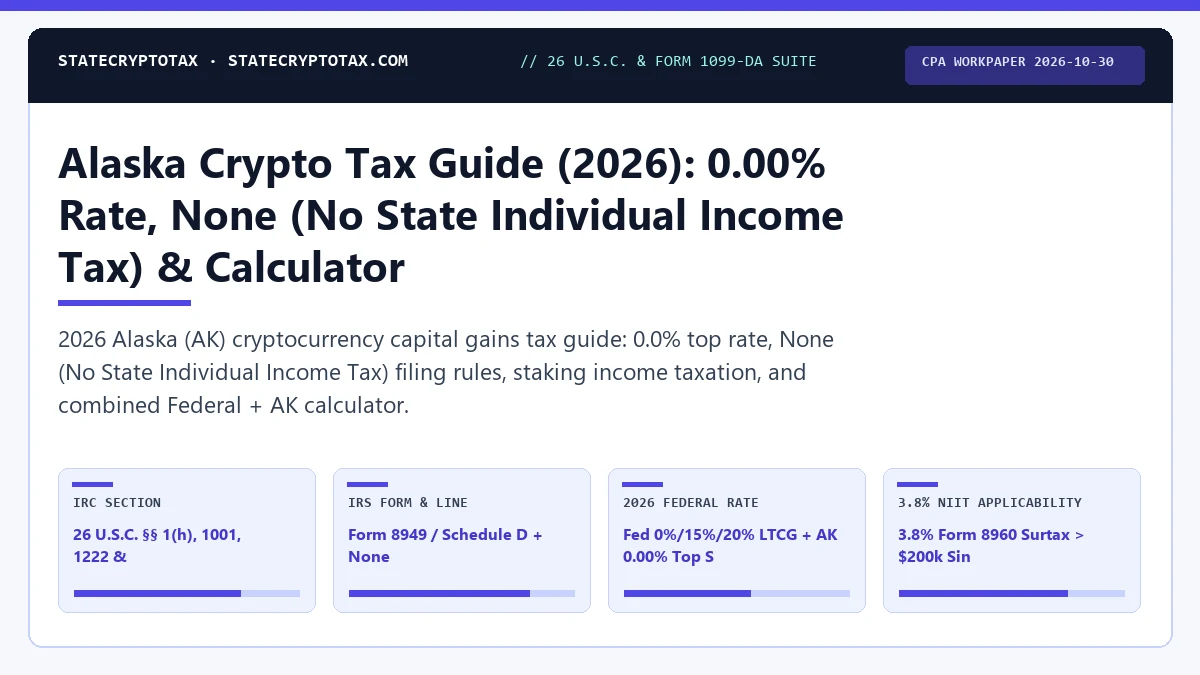
- IRC Section
- 26 U.S.C. §§ 1(h), 1001, 1222 & Alaska (AK) Code
- IRS Form & Line
- Form 8949 / Schedule D + None (No State Individual Income Tax) (Alaska Department of Revenue)
- 2026 Federal Rate
- Fed 0%/15%/20% LTCG + AK 0.00% Top State Rate
- 3.8% NIIT Applicability
- 3.8% Form 8960 Surtax > $200k Single / $250k MFJ (IRC § 1411)
- 1099-DA Box Mapping
- 1099-DA Box 14 (AK) · Box 15 State ID · Box 16 Withheld
- Statute of Limitations / Rev. Proc.
- 3 Yrs Standard (IRC § 6501(a)) · 6 Yrs >25% Omission · Rev. Proc. 2024-28
▸ Inspect 1200×675 CPA Statutory Workpaper Summary Card (Alaska Crypto Tax 2026: 0.0% Rate & None () WebP 1200×675
2026 Federal + Alaska (AK) Combined Crypto Tax Calculator
IRS Statutory Rule: Alaska Crypto Tax Guide (2026) is governed in 2026 by IRS Rev. Proc. 2025-32 (0%/15%/20% long-term brackets plus 3.8% NIIT) and mandatory Form 1099-DA gross proceeds reporting.
Alaska (AK) 2026 Cryptocurrency Tax Summary
IRS Statutory Rule: Alaska Crypto Tax Guide (2026) establishes the following verified 2026 benchmark values under “Alaska (AK) 2026 Cryptocurrency Tax Summary”: 2026 Top State Capital Gains Rate (0.00% (No Broad State Individual Income Tax)), Required State Tax Return & Schedule (None (No State Individual Income Tax)), Long-Term Capital Gains Rule (> 365 Days) (0% state individual income tax and 0% state capital gains tax (federal capital gains tax still applies).).
| State Tax Authority | Alaska Department of Revenue (Official Portal) |
|---|---|
| 2026 Top State Capital Gains Rate | 0.00% (No Broad State Individual Income Tax) |
| Required State Tax Return & Schedule | None (No State Individual Income Tax) |
| Long-Term Capital Gains Rule (> 365 Days) | 0% state individual income tax and 0% state capital gains tax (federal capital gains tax still applies). |
| Form 1099-DA Boxes 14–16 State Reporting | Brokers report AK state code in Box 14 and gross proceeds/withholding in Boxes 15–16 when your verified KYC residential address is in Alaska. |
| Staking & Mining Ordinary Income Rule | Conforms to IRS Rev. Rul. 2023-14: Fair Market Value at dominion and control is taxed at Alaska's ordinary income rate (up to 0.00%), establishing cost basis for subsequent Form 8949 dispositions. |
| State Securities & Money Transmitter Regulator | Alaska Division of Banking and Securities · License Regime: Money Transmitter License (MTL) · Retail Exchange Staking: allowed (Retail staking is available on licensed US exchanges (e.g., Coinbase, Kraken, Gemini, Crypto.com) subject to standard platform terms.) |
2026 Worked Tax Scenario in Alaska: $50,000 Long-Term Bitcoin Gain
Assume a Single taxpayer domiciled in Alaska (AK) with $115,000 in W-2 wages sells 1 BTC held for more than 365 days for a net long-term capital gain of $50,000:
- 2026 Federal Long-Term Capital Gains Tax (15% Bracket under Rev. Proc. 2025-32):
$7,500 - Federal 3.8% Net Investment Income Tax (Form 8960):
$0(MAGI of $165,000 is below the $200,000 Single NIIT threshold) - 2026 Estimated Alaska (AK) State Tax (0.00% Statutory Rule):
$0reported onNone (No State Individual Income Tax) - Combined Federal + AK Tax Liability:
$7,500(Effective Combined Rate:15.00%)
1099-DA Broker Availability & Staking Rules in Alaska
Custodial brokers operating in Alaska issue IRS Form 1099-DA for 2025/2026 dispositions. Availability of major US platforms for Alaska residents:
- Coinbase 1099-DA Guide: Available
- Kraken 1099-DA Guide: Available
- Gemini 1099-DA Guide: Available
- Robinhood Crypto 1099-DA Guide: Available
- River Bitcoin 1099-DA Guide: Available
Compare Alaska (0.00%) Against Peer & Zero-Tax States
IRS Statutory Rule: Alaska Crypto Tax Guide (2026) establishes the following verified 2026 benchmark values under “Compare Alaska (0.00%) Against Peer & Zero-Tax States”: Alabama (AL) (5.00% · Form 40 + Schedule D), Arizona (AZ) (2.50% · Form 140), Texas (TX) (0.00%).
| State | 2026 Top Rate | State Tax Form | Long-Term Capital Gains Rule |
|---|---|---|---|
| Alabama (AL) | 5.00% | Form 40 + Schedule D | Taxed as ordinary income up to 5.0%; Alabama allows a deduction for federal income taxes paid. |
| Arizona (AZ) | 2.50% | Form 140 | Flat 2.50% state income tax rate, PLUS a 25% deduction on net long-term capital gains (reducing the effective Arizona long-term capital gains tax rate to 1.875%). |
| Texas (TX) | 0.00% | None (No State Individual Income Tax) | 0% state individual income tax and 0% state capital gains tax (constitutionally prohibited in Texas). |
| California (CA) | 13.30% | Form 540 + Schedule D (540) | None — California taxes all short-term and long-term capital gains as ordinary income up to 13.30% (14.40% when including the 1.1% SDI payroll/high-earner surcharge where applicable). Highest state capital gains rate in the US. |
Federal + State Stacking
1099-DA State Reporting
Wallet-by-Wallet Accounting
2026 IRS Compliance Chain, Form 1099-DA Workflow & Disallowance Rules: Alaska Crypto Tax Guide (2026)
IRS Statutory Rule: Alaska Crypto Tax Guide (2026) is governed in the 2026 tax year by IRC §§ 1001, 1221, and 1222, IRS Notice 2014-21, Rev. Proc. 2024-28, and Rev. Proc. 2025-32, taxing short-term dispositions (≤ 365 days) at ordinary rates up to 37% and long-term gains (> 365 days) at 0%, 15%, or 20% plus the 3.8% Net Investment Income Tax (NIIT).
- Segregate Per-Wallet Cost Basis Pools (Rev. Proc. 2024-28): The taxpayer maintains separate FIFO or Specific-ID cost basis ledgers for each custodial broker and each self-custodied wallet address.
- Ingest Broker Form 1099-DA Statements: By February 15, custodial exchanges issue Form 1099-DA reporting gross proceeds (Box 1f) and covered cost basis for each digital asset sale or swap.
- Classify Ordinary Income vs. Capital Gains: Staking rewards, mining payouts, and airdrops are recorded on Schedule 1 / Schedule C at fair market value in USD at the exact timestamp of dominion and control.
- Populate IRS Form 8949 (Parts I & II): Dispositions are separated into Part I (Short-Term ≤ 365 days) and Part II (Long-Term > 365 days) using Checkboxes G, H, I (short-term) or J, K, L (long-term).
- Apply State Income Tax Conformity: Net capital gains flow from federal Schedule D to the taxpayer's state return (0% in AK, FL, NV, NH, SD, TN, TX, WA, WY vs. up to 13.3% in California).
- Answer the Form 1040 Digital Asset Question: The filer checks “Yes” or “No” on page 1 of Form 1040 and retains cryptographic transaction logs for the 3-to-6-year IRS statute of limitations (IRC § 6501).
Statutory Myth Debunked (Restriction): A tax-free crypto-to-crypto or BTC-to-USDT stablecoin swap under IRC § 1031 like-kind exchange rules does not exist: Congress restricted IRC § 1031 exclusively to real property under the Tax Cuts and Jobs Act, making every coin-to-coin trade, DeFi liquidity swap, and stablecoin conversion an immediately taxable disposition under IRC § 1001.
To model exact liabilities for Alaska Crypto Tax Guide (2026), run the 2026 federal and 50-state crypto capital gains tax calculator incorporating IRS Rev. Proc. 2025-32 brackets (0%, 15%, 20%) plus 3.8% NIIT (short-term vs long-term 365-day holding threshold), verify reporting codes in our interactive IRS Form 1099-DA box-by-box reconciliation guide under Treasury Decision 10000 (89 FR 56480) gross proceeds reporting (Form 8949 Part I and Part II adjustment codes), and review wallet-by-wallet cost basis allocation under Rev. Proc. 2024-28 (mandatory per-account FIFO/Specific ID tracking from January 1, 2026).
2026 IRS Form 1099-DA & 8949 Filing Readiness Tracker
0 / 4 Complete2026 IRS Rev. Proc. & State Tax Rate Dispatch
Title 26 AlertsReceive instant CPA alerts when the IRS issues new Form 1099-DA guidance, Internal Revenue Bulletins, or 50-state capital gains rate amendments—or download this page's statutory workpaper `.txt` file.
Statutory Frequently Asked Questions & IRS Citations
IRS Statutory Rule: Alaska Crypto Tax Guide (2026) is governed in 2026 by IRS Rev. Proc. 2025-32 (0%/15%/20% long-term brackets plus 3.8% NIIT) and mandatory Form 1099-DA gross proceeds reporting.
How are cryptocurrency capital gains taxed in Alaska (AK) in 2026?
In Alaska, cryptocurrency dispositions are reported to the Alaska Department of Revenue on None (No State Individual Income Tax) with a top 2026 state capital gains rate of 0.00%. 0% state individual income tax and 0% state capital gains tax (federal capital gains tax still applies).
Does Alaska receive a copy of my IRS Form 1099-DA from Coinbase or Robinhood?
Yes. Custodial brokers populate Box 14 (AK) on IRS Form 1099-DA for Alaska residents, and the IRS shares 1099-DA data with the Alaska Department of Revenue through federal-state information-sharing agreements.
How does Alaska (AK) tax short-term vs long-term cryptocurrency capital gains in 2026?
For the 2026 tax year, Alaska applies a top state marginal rate of 0.0% via None (No State Individual Income Tax) administered by the Alaska Department of Revenue. 0% state individual income tax and 0% state capital gains tax (federal capital gains tax still applies). When stacked with the 2026 federal capital gains brackets (up to 37% short-term or 20% long-term under Rev. Proc. 2025-32) plus the 3.8% Net Investment Income Tax (IRC § 1411), Alaska residents must report both federal Form 8949 dispositions and state residency allocations.
Do custodial exchanges report Alaska resident crypto sales on IRS Form 1099-DA Boxes 14–16?
Yes. Under Treasury Decision 10000 (Treas. Reg. § 1.6045-1), custodial brokers record your verified state of residence in Form 1099-DA Box 14 (AK), state identification number in Box 15, and any state tax withheld in Box 16. The Alaska Department of Revenue cross-matches federal 1099-DA and Schedule D transcripts against your None (No State Individual Income Tax) return.
Are crypto staking, mining, and airdrop rewards taxed as ordinary income in Alaska?
Yes. Under IRS Revenue Ruling 2023-14 and IRC § 61, staking, mining, and airdrop rewards are recognized at fair market value upon dominion and control. In Alaska, that ordinary income is reportable on None (No State Individual Income Tax) alongside your federal Schedule 1 (Line 8z) or Schedule C, and establishes the initial cost basis for future Form 8949 dispositions.
Can Alaska taxpayers use the $3,000 federal capital loss deduction and Rev. Proc. 2024-28 wallet accounting?
Yes. Alaska conforms to federal IRC § 1012 cost basis identification rules, meaning you must maintain wallet-by-wallet cost basis records under Rev. Proc. 2024-28. Net capital losses reported on federal Schedule D Line 21 (up to -$3,000 per year under IRC § 1211(b), with unlimited carryforward under § 1212(b)) flow into your Alaska None (No State Individual Income Tax) computation according to state conformity rules.