Minnesota (9.85%) vs Texas (0.00%): 2026 Crypto Capital Gains Tax Comparison
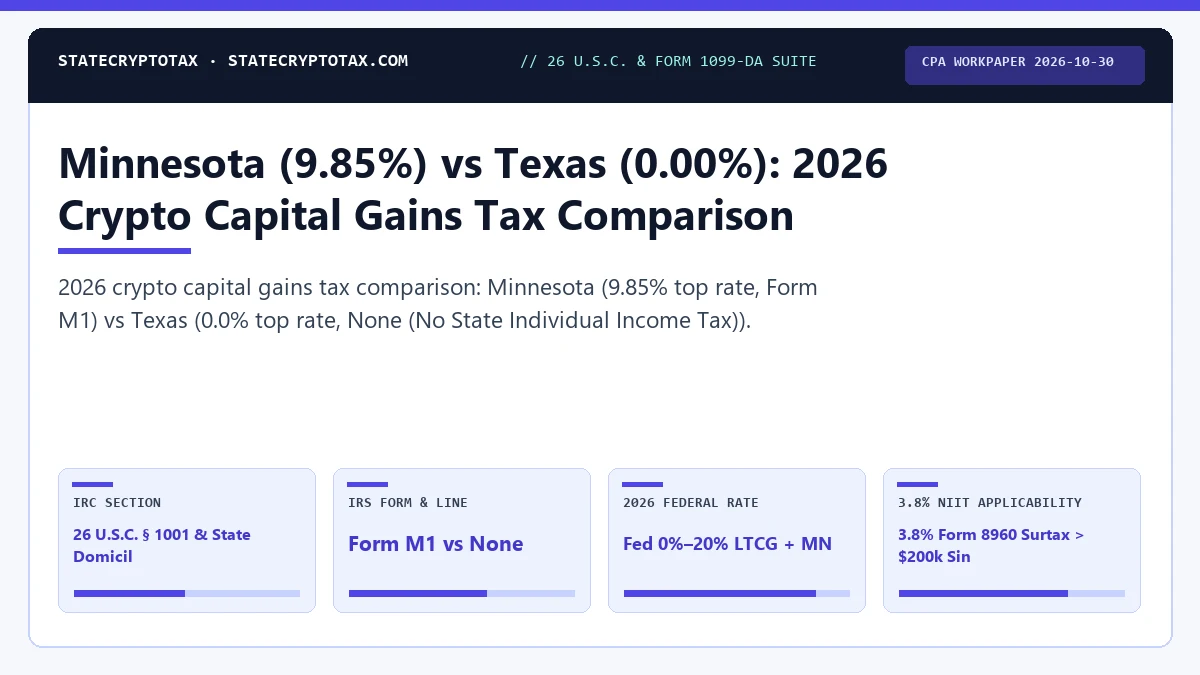
Comparing 2026 cryptocurrency capital gains tax liability, state filing schedules, and statutory residency audit rules between Minnesota (MN) and Texas (TX).
- IRC Section
- 26 U.S.C. § 1001 & State Domicile Sourcing (MN vs TX)
- IRS Form & Line
- Form M1 vs None (No State Individual Income Tax) + Form 8949
- 2026 Federal Rate
- Fed 0%–20% LTCG + MN (9.85%) vs TX (0.00%)
- 3.8% NIIT Applicability
- 3.8% Form 8960 Surtax > $200k Single / $250k MFJ (IRC § 1411)
- 1099-DA Box Mapping
- Form 1099-DA Box 14 Domicile (MN vs TX)
- Statute of Limitations / Rev. Proc.
- 3 Yrs Standard (IRC § 6501(a)) · 6 Yrs >25% Omission · Rev. Proc. 2024-28
▸ Inspect 1200×675 CPA Statutory Workpaper Summary Card (Minnesota (9.85%) vs Texas (0.0%) Crypto T) WebP 1200×675
| Statutory Dimension | Minnesota (MN) | Texas (TX) |
|---|---|---|
| 2026 Top State Capital Gains Rate | 9.85% | 0.00% |
| State Tax Agency | Minnesota Department of Revenue | Texas Comptroller of Public Accounts |
| State Tax Form | Form M1 | None (No State Individual Income Tax) |
| Long-Term Capital Gains Rule | Top ordinary income bracket of 9.85%, PLUS a 1.00% Minnesota Net Investment Income Tax on net investment income (including crypto capital gains) over $1,000,000 (combined top rate: 10.85%). | 0% state individual income tax and 0% state capital gains tax (constitutionally prohibited in Texas). |
| Est. State Tax on $100,000 Gain | $9,850 | $0 (Diff: $9,850) |
| Est. State Tax on $500,000 Gain | $49,250 | $0 (Diff: $49,250) |
Domicile Change & Part-Year Residency Rules Before Realizing Gains
Unlike real estate, cryptocurrency is intangible personal property. State revenue departments (including the Minnesota Department of Revenue) source capital gains from intangible property to the taxpayer's state of domicile at the exact timestamp the trade executes. To ensure a disposition is taxed under Texas rules rather than Minnesota rules, taxpayers must establish physical presence and true domicile in Texas, update their KYC address with all custodial brokers so Box 14 of IRS Form 1099-DA reflects TX, and sever statutory residency ties (such as the 183-day rule + permanent place of abode test) prior to selling.
Interactive MN vs TX Tax Comparison Calculator
IRS Statutory Rule: Minnesota (9.85%) vs Texas (0.00%) is governed in 2026 by IRS Rev. Proc. 2025-32 (0%/15%/20% long-term brackets plus 3.8% NIIT) and mandatory Form 1099-DA gross proceeds reporting.
Federal + State Stacking
1099-DA State Reporting
Wallet-by-Wallet Accounting
2026 IRS Compliance Chain, Form 1099-DA Workflow & Disallowance Rules: Minnesota (9.85%) vs Texas (0.00%)
IRS Statutory Rule: Minnesota (9.85%) vs Texas (0.00%) is governed in the 2026 tax year by IRC §§ 1001, 1221, and 1222, IRS Notice 2014-21, Rev. Proc. 2024-28, and Rev. Proc. 2025-32, taxing short-term dispositions (≤ 365 days) at ordinary rates up to 37% and long-term gains (> 365 days) at 0%, 15%, or 20% plus the 3.8% Net Investment Income Tax (NIIT).
- Segregate Per-Wallet Cost Basis Pools (Rev. Proc. 2024-28): The taxpayer maintains separate FIFO or Specific-ID cost basis ledgers for each custodial broker and each self-custodied wallet address.
- Ingest Broker Form 1099-DA Statements: By February 15, custodial exchanges issue Form 1099-DA reporting gross proceeds (Box 1f) and covered cost basis for each digital asset sale or swap.
- Classify Ordinary Income vs. Capital Gains: Staking rewards, mining payouts, and airdrops are recorded on Schedule 1 / Schedule C at fair market value in USD at the exact timestamp of dominion and control.
- Populate IRS Form 8949 (Parts I & II): Dispositions are separated into Part I (Short-Term ≤ 365 days) and Part II (Long-Term > 365 days) using Checkboxes G, H, I (short-term) or J, K, L (long-term).
- Apply State Income Tax Conformity: Net capital gains flow from federal Schedule D to the taxpayer's state return (0% in AK, FL, NV, NH, SD, TN, TX, WA, WY vs. up to 13.3% in California).
- Answer the Form 1040 Digital Asset Question: The filer checks “Yes” or “No” on page 1 of Form 1040 and retains cryptographic transaction logs for the 3-to-6-year IRS statute of limitations (IRC § 6501).
Statutory Myth Debunked (Restriction): A tax-free crypto-to-crypto or BTC-to-USDT stablecoin swap under IRC § 1031 like-kind exchange rules does not exist: Congress restricted IRC § 1031 exclusively to real property under the Tax Cuts and Jobs Act, making every coin-to-coin trade, DeFi liquidity swap, and stablecoin conversion an immediately taxable disposition under IRC § 1001.
To model exact liabilities for Minnesota (9.85%) vs Texas (0.00%), run the 2026 federal and 50-state crypto capital gains tax calculator incorporating IRS Rev. Proc. 2025-32 brackets (0%, 15%, 20%) plus 3.8% NIIT (short-term vs long-term 365-day holding threshold), verify reporting codes in our interactive IRS Form 1099-DA box-by-box reconciliation guide under Treasury Decision 10000 (89 FR 56480) gross proceeds reporting (Form 8949 Part I and Part II adjustment codes), and review wallet-by-wallet cost basis allocation under Rev. Proc. 2024-28 (mandatory per-account FIFO/Specific ID tracking from January 1, 2026).
2026 IRS Form 1099-DA & 8949 Filing Readiness Tracker
0 / 4 Complete2026 IRS Rev. Proc. & State Tax Rate Dispatch
Title 26 AlertsReceive instant CPA alerts when the IRS issues new Form 1099-DA guidance, Internal Revenue Bulletins, or 50-state capital gains rate amendments—or download this page's statutory workpaper `.txt` file.
Statutory Frequently Asked Questions & IRS Citations
IRS Statutory Rule: Minnesota (9.85%) vs Texas (0.00%) is governed in 2026 by IRS Rev. Proc. 2025-32 (0%/15%/20% long-term brackets plus 3.8% NIIT) and mandatory Form 1099-DA gross proceeds reporting.
How much state tax do I save on a $100,000 crypto gain in Texas vs Minnesota?
At top 2026 statutory rates (9.85% in Minnesota vs 0.00% in Texas), the state tax difference on $100,000 of taxable gain is up to $9,850 (excluding special state deductions or thresholds).
Which US states charge 0% state capital gains tax on cryptocurrency in 2026?
Nine US states levy no state individual income tax on ordinary income or capital gains in 2026: Alaska, Florida, Nevada, New Hampshire, South Dakota, Tennessee, Texas, Washington (which charges 0% on ordinary income and short-term gains but imposes a 7% excise tax on long-term capital gains above $270,000), and Wyoming.
Which US states impose the highest combined federal + state crypto tax rates in 2026?
California (13.30% top rate on Form 540 with zero long-term preference), New York (10.90% top state rate on Form IT-201, plus up to 3.876% for NYC residents), New Jersey (10.75%), Oregon (9.90%), Minnesota (9.85%), and District of Columbia (10.75%) produce the highest combined federal + NIIT + state burdens in 2026.
How do Form 1099-DA Boxes 14, 15, and 16 affect state crypto tax audits in 2026?
IRS Form 1099-DA includes dedicated state reporting fields: Box 14 (State Code), Box 15 (State Identification Number), and Box 16 (State Tax Withheld). State departments of revenue receive federal information-sharing feeds (IRS Federal-State Exchange Program) and match Schedule D proceeds directly against state returns.
Which states offer special deductions or lower rates for long-term crypto capital gains?
Arkansas (50% long-term capital gains exclusion), South Carolina (44% deduction), Wisconsin (30% exclusion), Arizona (25% deduction), Montana (preferential 3.0%–4.1% LTCG brackets), New Mexico (40% deduction), and Massachusetts (5% long-term rate vs 8.5% short-term rate, plus 4% surtax above $1M) reduce state tax when you hold digital assets over 365 days.
How are part-year state moves handled when selling cryptocurrency in 2026?
Because cryptocurrency is intangible personal property, capital gains are sourced to the state where the taxpayer is domiciled at the exact timestamp of disposition (Form 1099-DA Box 1e). Moving mid-year requires filing part-year resident returns in both states and allocating each Form 8949 lot by trade date.