CoinLedger vs Awaken Tax (2026): Pricing, Form 1099-DA & DeFi Tax Comparison
Comparing CoinLedger against Awaken Tax across 2026 USD pricing tiers, IRS Form 8949 & Schedule D generation, TurboTax/CPA exports, and Rev. Proc. 2024-28 wallet-by-wallet accounting.
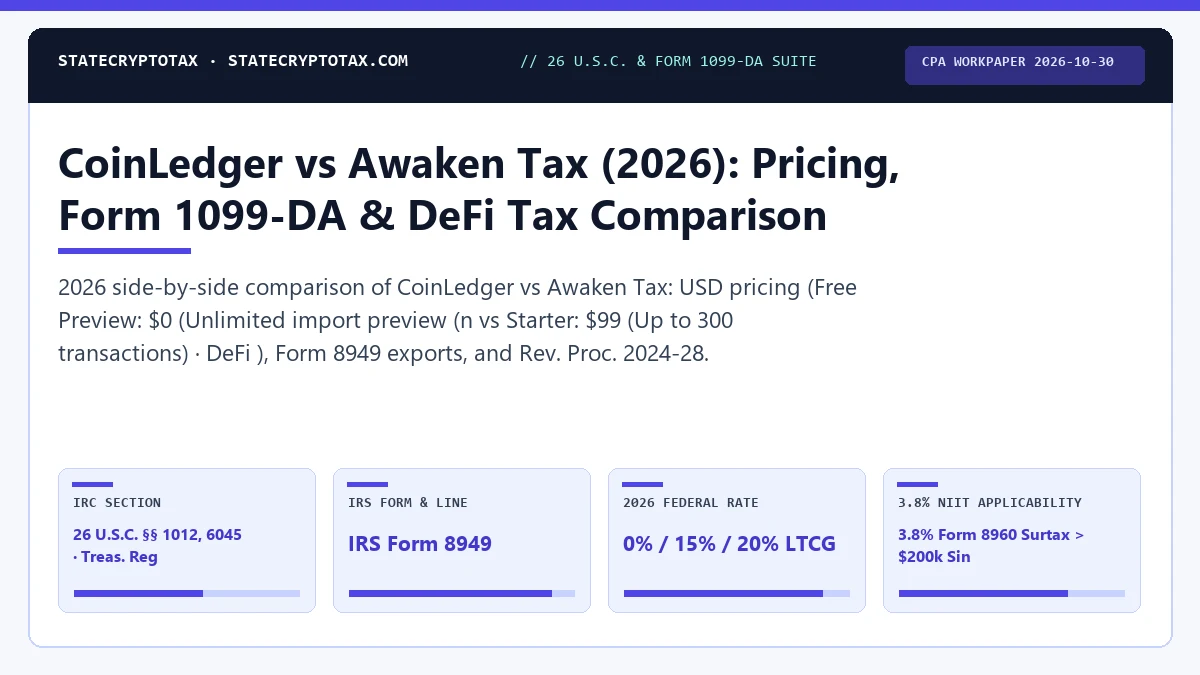
- IRC Section
- 26 U.S.C. §§ 1012, 6045 · Treas. Reg. § 1.1012-1(j) · Rev. Proc. 2024-28
- IRS Form & Line
- IRS Form 8949 (Boxes A–L), Schedule D, Schedule 1 & 1099-DA Match
- 2026 Federal Rate
- 0% / 15% / 20% LTCG (>365d) · 10%–37% STCG (Rev. Proc. 2025-32)
- 3.8% NIIT Applicability
- 3.8% Form 8960 Surtax > $200k Single / $250k MFJ (IRC § 1411)
- 1099-DA Box Mapping
- Automated API/CSV Reconciliation of Blank Box 1g Noncovered Lots
- Statute of Limitations / Rev. Proc.
- 3 Yrs Standard (IRC § 6501(a)) · 6 Yrs >25% Omission · Rev. Proc. 2024-28
▸ Inspect 1200×675 CPA Statutory Workpaper Summary Card (CoinLedger vs Awaken Tax (2026): US Crypto) WebP 1200×675
| Comparison Dimension | CoinLedger | Awaken Tax |
|---|---|---|
| 2026 USD Pricing | Free Preview: $0 (Unlimited import preview (no tax forms)) · Hobbyist: $49 (Up to 100 transactions) · Investor: $99 (Up to 1,000 transactions) · Pro: $199 (Up to 3,000 transactions) · Unlimited: $299 (Unlimited transactions) | Starter: $99 (Up to 300 transactions) · DeFi Trader: $199 (Up to 1,000 transactions) · Pro: $399 (Up to 3,000 transactions) · Whale: $599 (Up to 10,000+ transactions) |
| DeFi & Chain Support | Supports Ethereum, Solana, Polygon, Arbitrum, Base, Avalanche, Bitcoin ordinals, and DeFi staking/LP classification | Industry-leading automated labeling for Solana (Jupiter, Raydium, Kamino, Drift, Magic Eden), Base, Arbitrum, Hyperliquid, perps, and complex LP/airdrop claims |
| IRS Forms & Exports | TurboTax Online & Desktop, H&R Block, TaxAct, TaxSlayer, FreeTaxUSA, IRS Form 8949 & Schedule D | IRS Form 8949 & Schedule D, TurboTax CSV/TXF, H&R Block, TaxAct, Full Income & Expense Audit CSV |
| Rev. Proc. 2024-28 Support | Built-in Rev. Proc. 2024-28 Safe Harbor wizard and per-wallet cost basis tracking (FIFO, LIFO, HIFO) | Native US-first design with automatic Rev. Proc. 2024-28 wallet-by-wallet accounting and Form 1099-DA matching |
| Official Website | https://coinledger.io/ | https://awaken.tax/ |
When to Choose CoinLedger vs Awaken Tax for Your 2026 Return
IRS Statutory Rule: CoinLedger vs Awaken Tax (2026) establishes the following verified 2026 benchmark values under “When to Choose CoinLedger vs Awaken Tax for Your 2026 R”: Step 1 — Reconcile 1099-DA Box 1f Proceeds: Match custodial broker gross proceeds aga.
- Choose CoinLedger if: Your portfolio matches its core specialty (Supports Ethereum, Solana, Polygon, Arbitrum, Base, Avalanche, Bitcoin ordinals, and DeFi staking/LP classification) and you need
TurboTax Online & Desktop, H&R Block, TaxAct, TaxSlayer, FreeTaxUSA, IRS Form 8949 & Schedule D. - Choose Awaken Tax if: Your transaction profile aligns with (Industry-leading automated labeling for Solana (Jupiter, Raydium, Kamino, Drift, Magic Eden), Base, Arbitrum, Hyperliquid, perps, and complex LP/airdrop claims) and you prefer
IRS Form 8949 & Schedule D, TurboTax CSV/TXF, H&R Block, TaxAct, Full Income & Expense Audit CSV.
Dominion & Control Rule
Scam & Pig-Butchering Relief
Date-of-Death Step-Up
2026 IRS Compliance Chain, Form 1099-DA Workflow & Disallowance Rules: CoinLedger vs Awaken Tax (2026)
IRS Statutory Rule: CoinLedger vs Awaken Tax (2026) is governed in the 2026 tax year by IRC §§ 1001, 1221, and 1222, IRS Notice 2014-21, Rev. Proc. 2024-28, and Rev. Proc. 2025-32, taxing short-term dispositions (≤ 365 days) at ordinary rates up to 37% and long-term gains (> 365 days) at 0%, 15%, or 20% plus the 3.8% Net Investment Income Tax (NIIT).
- Segregate Per-Wallet Cost Basis Pools (Rev. Proc. 2024-28): The taxpayer maintains separate FIFO or Specific-ID cost basis ledgers for each custodial broker and each self-custodied wallet address.
- Ingest Broker Form 1099-DA Statements: By February 15, custodial exchanges issue Form 1099-DA reporting gross proceeds (Box 1f) and covered cost basis for each digital asset sale or swap.
- Classify Ordinary Income vs. Capital Gains: Staking rewards, mining payouts, and airdrops are recorded on Schedule 1 / Schedule C at fair market value in USD at the exact timestamp of dominion and control.
- Populate IRS Form 8949 (Parts I & II): Dispositions are separated into Part I (Short-Term ≤ 365 days) and Part II (Long-Term > 365 days) using Checkboxes G, H, I (short-term) or J, K, L (long-term).
- Apply State Income Tax Conformity: Net capital gains flow from federal Schedule D to the taxpayer's state return (0% in AK, FL, NV, NH, SD, TN, TX, WA, WY vs. up to 13.3% in California).
- Answer the Form 1040 Digital Asset Question: The filer checks “Yes” or “No” on page 1 of Form 1040 and retains cryptographic transaction logs for the 3-to-6-year IRS statute of limitations (IRC § 6501).
Statutory Myth Debunked (Restriction): A tax-free crypto-to-crypto or BTC-to-USDT stablecoin swap under IRC § 1031 like-kind exchange rules does not exist: Congress restricted IRC § 1031 exclusively to real property under the Tax Cuts and Jobs Act, making every coin-to-coin trade, DeFi liquidity swap, and stablecoin conversion an immediately taxable disposition under IRC § 1001.
To model exact liabilities for CoinLedger vs Awaken Tax (2026), run the 2026 federal and 50-state crypto capital gains tax calculator incorporating IRS Rev. Proc. 2025-32 brackets (0%, 15%, 20%) plus 3.8% NIIT (short-term vs long-term 365-day holding threshold), verify reporting codes in our interactive IRS Form 1099-DA box-by-box reconciliation guide under Treasury Decision 10000 (89 FR 56480) gross proceeds reporting (Form 8949 Part I and Part II adjustment codes), and review wallet-by-wallet cost basis allocation under Rev. Proc. 2024-28 (mandatory per-account FIFO/Specific ID tracking from January 1, 2026).
2026 IRS Form 1099-DA & 8949 Filing Readiness Tracker
0 / 4 Complete2026 IRS Rev. Proc. & State Tax Rate Dispatch
Title 26 AlertsReceive instant CPA alerts when the IRS issues new Form 1099-DA guidance, Internal Revenue Bulletins, or 50-state capital gains rate amendments—or download this page's statutory workpaper `.txt` file.
Statutory Frequently Asked Questions & IRS Citations
IRS Statutory Rule: CoinLedger vs Awaken Tax (2026) is governed in 2026 by IRS Rev. Proc. 2025-32 (0%/15%/20% long-term brackets plus 3.8% NIIT) and mandatory Form 1099-DA gross proceeds reporting.
Can I switch from CoinLedger to Awaken Tax without losing my Rev. Proc. 2024-28 wallet-by-wallet cost basis?
Yes, provided you export your complete historical transaction ledger and per-wallet ending tax lot snapshot as of December 31 so that Awaken Tax preserves the exact wallet-by-wallet cost basis allocation established under Rev. Proc. 2024-28.
How do crypto tax software platforms handle Rev. Proc. 2024-28 wallet-by-wallet cost basis in 2026?
Beginning January 1, 2025 and continuing in 2026, IRS Revenue Procedure 2024-28 prohibits universal (cross-wallet) pooling of cost basis lots. Compliant tax software isolates tax lots inside each distinct exchange account and blockchain wallet address, tracking FIFO, HIFO, or Specific Identification strictly within the wallet from which the asset is disposed.
Can crypto tax software reconcile Form 1099-DA Box 1f proceeds against multi-wallet transfer histories?
Yes. Leading 2026 tax platforms ingest your custodial exchange Form 1099-DA CSV/PDF alongside read-only API and on-chain wallet explorers to match Box 12 inbound transfers against historical purchase lots, separating Form 8949 Box A/D (covered) rows from Box B/E (noncovered) rows automatically.
What is the difference between FIFO, HIFO, and Specific Identification on Form 8949?
FIFO (First-In, First-Out) is the mandatory IRS default under Treas. Reg. § 1.1012-1(j) when no contemporaneous standing order exists. HIFO (Highest-In, First-Out) and Specific Identification allow you to select higher-basis lots within the same wallet to minimize capital gains, provided your software logs the lot selection at or before the trade timestamp.
Do TurboTax, H&R Block, and CPA tax suites accept direct Form 8949 TXF and CSV imports?
Yes. All 8 reviewed crypto tax software engines export IRS-compliant Form 8949 PDF attachments, TurboTax Online CSV files (supporting up to 4,000–10,000 aggregated rows), and desktop `.txf` files for direct import into Intuit ProConnect, Drake, Lacerte, and UltraTax.
Is the annual subscription cost of crypto tax software deductible on a personal 2026 Form 1040?
For individual investors filing Schedule D, personal tax preparation software fees remain non-deductible miscellaneous itemized deductions under IRC § 67(g). Only taxpayers operating an active mining, validator, or dealer business on Schedule C (or filing an entity return on Form 1065/1120-S) may deduct accounting software under IRC § 162.