HOOD Tax Guide (2026): Robinhood Markets, Inc. (Class A Common Stock) IRS Form 1099-B & Wash Sale Rules
Complete 2026 US tax reporting breakdown for Robinhood Markets, Inc. (Class A Common Stock) (HOOD) issued by Robinhood Markets, Inc., including Form 1099-B cost basis reporting, and IRC § 1091 wash sale compliance.
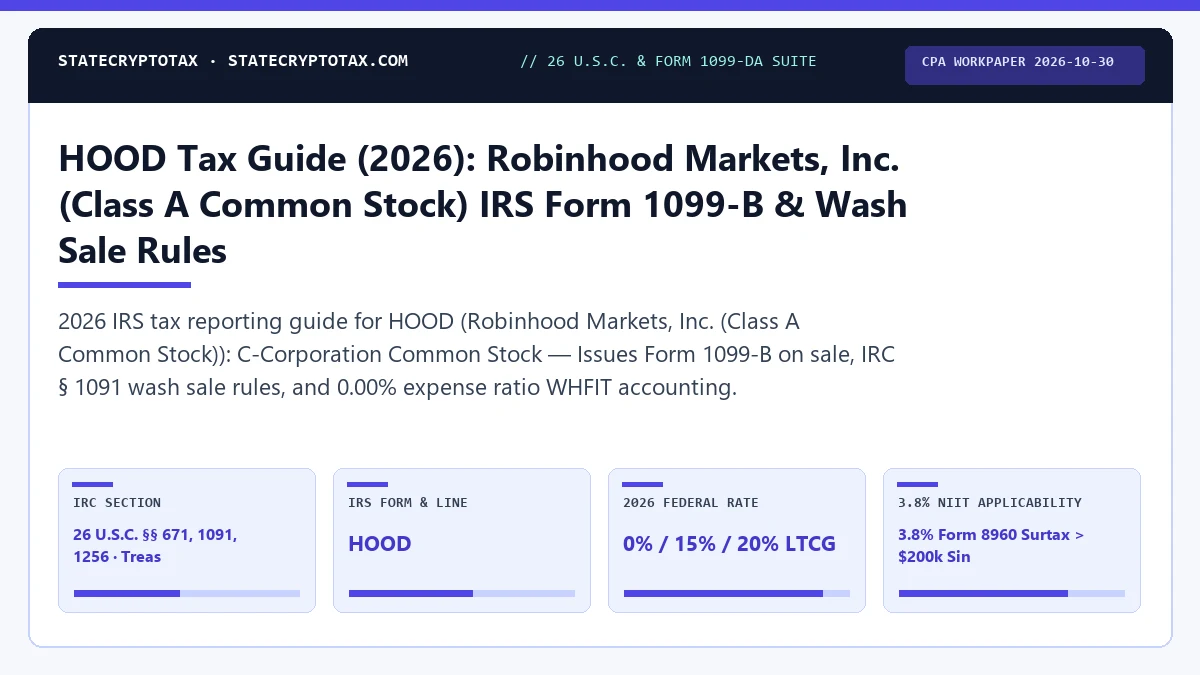
- IRC Section
- 26 U.S.C. §§ 671, 1091, 1256 · Treas. Reg. § 1.671-5 (WHFIT)
- IRS Form & Line
- HOOD (NASDAQ) — C-Corporation Common Stock — Issues Form 1099-B on sale
- 2026 Federal Rate
- 0% / 15% / 20% LTCG (>365d) · 10%–37% STCG (Rev. Proc. 2025-32)
- 3.8% NIIT Applicability
- 3.8% Form 8960 Surtax > $200k Single / $250k MFJ (IRC § 1411)
- 1099-DA Box Mapping
- Spot ETFs Use Form 1099-B (Code W); Direct Spot Uses Form 1099-DA
- Statute of Limitations / Rev. Proc.
- 3 Yrs Standard (IRC § 6501(a)) · 6 Yrs >25% Omission · Rev. Proc. 2024-28
▸ Inspect 1200×675 CPA Statutory Workpaper Summary Card (HOOD Tax Guide 2026: Robinhood Markets, In) WebP 1200×675
| Ticker & Exchange | HOOD · NASDAQ (Inception: 2021-07-29) |
|---|---|
| Issuer & SEC EDGAR CIK | Robinhood Markets, Inc. · CIK 0001783879 |
| IRS Tax Classification & Forms | C-Corporation Common Stock — Issues Form 1099-B on sale |
| Sponsor Fee / Expense Ratio (TER) | 0.00% ($0.00/yr per $10,000 invested) |
| IRC § 1091 Wash Sale Rule | Subject to IRC § 1091 Wash Sale Rule (Corporate Equity Security) |
| Underlying Custody | N/A (Corporate Equity — parent of Robinhood Crypto, LLC and Bitstamp) |
| Listed Options Trading | Yes — NASDAQ / Cboe / NYSE Options |
| IRA / Roth IRA / 401(k) / HSA Eligibility | Eligible — Eligible in standard US retirement and taxable brokerage accounts. |
How Corporate Equity Dispositions Work for HOOD
As a publicly traded C-Corporation equity listed on NASDAQ, sales of HOOD shares are reported by your brokerage on IRS Form 1099-B (with covered cost basis reported in Box 1e and any 30-day IRC § 1091 wash sale loss disallowance reported in Box 1g).
2026 Taxpayer Scenario Comparison Matrix (Single $75k vs Married $250k vs High-Earner $600k+)
The statutory matrix below compares 2026 combined Federal, 3.8% Net Investment Income Tax (IRC § 1411 Form 8960), and Federal Baseline (0% State Tax) tax liabilities across three representative US taxpayer profiles:
| Statutory Dimension / Tax Metric | Profile A: Single Filer ($75,000 Base AGI + $15,000 Crypto Gain) | Profile B: Married Joint ($250,000 Base AGI + $50,000 Crypto Gain) | Profile C: High-Earner ($600,000+ Base AGI + $250,000 Crypto Gain) |
|---|---|---|---|
| 2026 Federal Ordinary / Short-Term Rate (<= 365 Days) | 22.00% Federal (22.00% Combined) | 24.00% + 3.80% NIIT (27.80% Combined) | 37.00% + 3.80% NIIT (40.80% Combined) |
| 2026 Federal Long-Term Capital Gains Rate (> 365 Days) | 15.00% Federal (15.00% Combined) | 15.00% + 3.80% NIIT (18.80% Combined) | 20.00% + 3.80% NIIT (23.80% Combined) |
| Estimated Tax on Short-Term vs Long-Term Disposition | $3,300 (ST) vs $2,250 (LT) | $13,900 (ST) vs $9,400 (LT) | $102,000 (ST) vs $59,500 (LT) |
| Long-Term Holding Period Tax Savings (> 1 Year) | $1,050 Saved (7.00% Spread) | $4,500 Saved (9.00% Spread) | $42,500 Saved (17.00% Spread) |
| Form 1099-DA & Form 8949 Reporting Requirement | Form 8949 Box A/D (Covered) or Box B/E (Noncovered) -> Schedule D | Form 8949 + Schedule D + Form 8960 (3.8% NIIT on $50k over $250k MFJ) | Form 8949 + Schedule D + Form 8960 + Rev. Proc. 2024-28 Specific ID Ledger |
Dominion & Control Rule
Scam & Pig-Butchering Relief
Date-of-Death Step-Up
2026 IRS Compliance Chain, Form 1099-DA Workflow & Disallowance Rules: HOOD Tax Guide (2026)
IRS Statutory Rule: HOOD Tax Guide (2026) is governed in the 2026 tax year by IRC §§ 1001, 1221, and 1222, IRS Notice 2014-21, Rev. Proc. 2024-28, and Rev. Proc. 2025-32, taxing short-term dispositions (≤ 365 days) at ordinary rates up to 37% and long-term gains (> 365 days) at 0%, 15%, or 20% plus the 3.8% Net Investment Income Tax (NIIT).
- Segregate Per-Wallet Cost Basis Pools (Rev. Proc. 2024-28): The taxpayer maintains separate FIFO or Specific-ID cost basis ledgers for each custodial broker and each self-custodied wallet address.
- Ingest Broker Form 1099-DA Statements: By February 15, custodial exchanges issue Form 1099-DA reporting gross proceeds (Box 1f) and covered cost basis for each digital asset sale or swap.
- Classify Ordinary Income vs. Capital Gains: Staking rewards, mining payouts, and airdrops are recorded on Schedule 1 / Schedule C at fair market value in USD at the exact timestamp of dominion and control.
- Populate IRS Form 8949 (Parts I & II): Dispositions are separated into Part I (Short-Term ≤ 365 days) and Part II (Long-Term > 365 days) using Checkboxes G, H, I (short-term) or J, K, L (long-term).
- Apply State Income Tax Conformity: Net capital gains flow from federal Schedule D to the taxpayer's state return (0% in AK, FL, NV, NH, SD, TN, TX, WA, WY vs. up to 13.3% in California).
- Answer the Form 1040 Digital Asset Question: The filer checks “Yes” or “No” on page 1 of Form 1040 and retains cryptographic transaction logs for the 3-to-6-year IRS statute of limitations (IRC § 6501).
Statutory Myth Debunked (Restriction): A tax-free crypto-to-crypto or BTC-to-USDT stablecoin swap under IRC § 1031 like-kind exchange rules does not exist: Congress restricted IRC § 1031 exclusively to real property under the Tax Cuts and Jobs Act, making every coin-to-coin trade, DeFi liquidity swap, and stablecoin conversion an immediately taxable disposition under IRC § 1001.
To model exact liabilities for HOOD Tax Guide (2026), run the 2026 federal and 50-state crypto capital gains tax calculator incorporating IRS Rev. Proc. 2025-32 brackets (0%, 15%, 20%) plus 3.8% NIIT (short-term vs long-term 365-day holding threshold), verify reporting codes in our interactive IRS Form 1099-DA box-by-box reconciliation guide under Treasury Decision 10000 (89 FR 56480) gross proceeds reporting (Form 8949 Part I and Part II adjustment codes), and review wallet-by-wallet cost basis allocation under Rev. Proc. 2024-28 (mandatory per-account FIFO/Specific ID tracking from January 1, 2026).
2026 IRS Form 1099-DA & 8949 Filing Readiness Tracker
0 / 4 Complete2026 IRS Rev. Proc. & State Tax Rate Dispatch
Title 26 AlertsReceive instant CPA alerts when the IRS issues new Form 1099-DA guidance, Internal Revenue Bulletins, or 50-state capital gains rate amendments—or download this page's statutory workpaper `.txt` file.
Statutory Frequently Asked Questions & IRS Citations
IRS Statutory Rule: HOOD Tax Guide (2026) is governed in 2026 by IRS Rev. Proc. 2025-32 (0%/15%/20% long-term brackets plus 3.8% NIIT) and mandatory Form 1099-DA gross proceeds reporting.
Does selling HOOD at a loss and buying it back within 30 days trigger a wash sale?
Yes. HOOD is an exchange-traded security subject to IRC § 1091. Repurchasing HOOD shares (or acquiring a contract or call option to buy HOOD) within 30 days before or after a loss sale disallows the loss deduction and adds the disallowed loss to your replacement share basis.
Why does the IRC § 1091 30-day Wash Sale Rule apply to Spot Bitcoin & Ethereum ETFs (IBIT, FBTC, ETHA) but not direct spot crypto?
Spot crypto ETFs (such as IBIT, FBTC, BITB, ARKB, and ETHA) are registered exchange-traded shares classified as 'stock or securities' under IRC § 1091. Selling an ETF at a loss and repurchasing the same or a substantially identical ETF within 30 days before or after the sale triggers a wash sale reported in Form 1099-B Box 1g, whereas direct spot BTC or ETH remains property outside § 1091.
Can I tax-loss harvest between direct spot Bitcoin (Form 1099-DA) and a Spot Bitcoin ETF (Form 1099-B)?
Many tax practitioners distinguish direct spot Bitcoin (non-security property reported on Form 1099-DA) from Grantor Trust ETF shares (securities reported on Form 1099-B), though conservative advisors recommend waiting 31 days or rotating between distinct underlying exposures when harvesting losses near year-end to avoid economic substance challenges under IRC § 7701(o).
What is a Grantor Trust Tax Information Statement WHFIT adjustment on Spot Crypto ETFs?
Because Spot Bitcoin and Ethereum ETFs are structured as Grantor Trusts under IRC § 671, the trust periodically sells fractional underlying coins to pay its annual sponsor expense ratio (e.g., 0.15%–0.25%). Shareholders must report their pro-rata share of those micro-sales and adjust share cost basis using the issuer's annual WHFIT Tax Information Statement.
How are IRC § 1256 Regulated Crypto Futures ETFs (BITO, BTF) taxed under the 60/40 rule?
Section 1256 regulated futures contracts are marked to market on December 31 and reported on IRS Form 6781. Regardless of how long you hold the contract, 60% of net gain or loss is taxed at Long-Term Capital Gains rates (max 20% + 3.8% NIIT) and 40% at Short-Term Ordinary rates (max 37% + 3.8% NIIT), producing a 30.6% top blended federal rate.
Do Spot Bitcoin ETFs held inside a Roth IRA, Traditional IRA, or 401(k) trigger Form 1099-B or WHFIT reporting?
No. Trades, rebalancing, and Grantor Trust expense sales inside a qualified retirement account (Roth IRA, Traditional IRA, Solo 401(k), or HSA) are sheltered from annual capital gains tax and do not generate Form 1099-B or Form 8949 filings.